Restoration of the garden monument officially launched
9 February 2026:
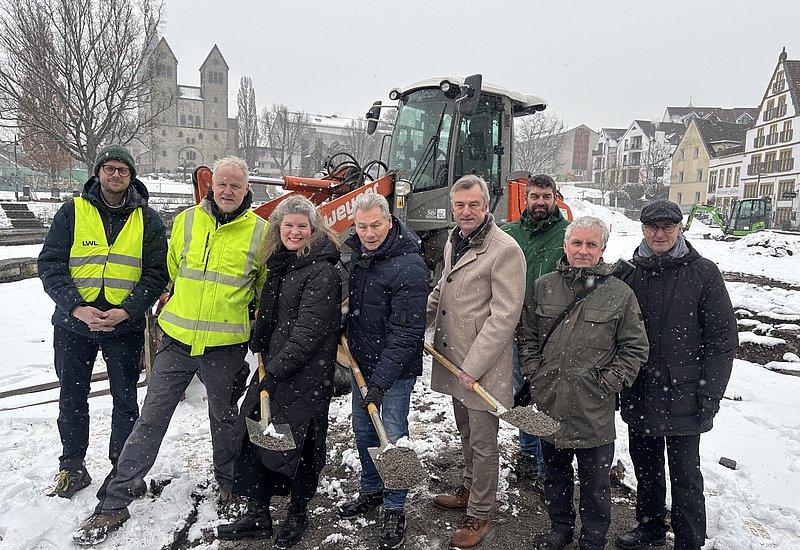
After preparatory work for the restoration of the garden monument in Paderborn began last year, the actual work in this area has now also started. Together with Deputy Mayor Robert Siemensmeyer, Jessica Schütte, head of the Office for Environmental Protection and Green Spaces, and Dietrich Honervogt, chairman of the Friends of the Pader Association, the ground-breaking ceremony has now taken place.
For residents, this means that the inner area of the western Pader spring area between Mühlenstraße, Am Damm, Bachstraße, Am Abdinghof, and Wasserkunst will initially be closed off. However, attempts will be made to reopen the area bit by bit, as construction progresses, starting from Bachstraße towards Mühlenstraße, so that the restaurants located on Bachstraße can quickly use their outdoor areas again.
The plan is to replant trees such as oak, maple, willow, and magnolia, as well as other shrubs and perennials. The trees will be carefully selected to match the historical model and be of a stately size. Some trees will already be 25 years old when they are planted in the garden monument. In addition, the stairs to the Abdinghof are to be renovated, as are three missing bridges, the path surfaces including lighting, and the event infrastructure. The outdoor dining area will also be redesigned. The heavily sealed playground in the garden monument, which was built in the 1990s, will be dismantled. Instead of a playground, there will be high-quality play islands staggered one behind the other and distributed throughout the area.
The work on the garden monument is being carried out in close cooperation with the Paderborn City Archaeology Department and the Lower Monument Authority of the City of Paderborn, as well as the Landschaftsverband Westfalen Lippe (Westphalia-Lippe Regional Association) based in Münster. The total cost, including planning, will be around €3.3 million, but this will be subsidized by up to 90 percent by the Ministry of Home Affairs, Local Government, Building, and Digitalization of the State of North Rhine-Westphalia, minus the €100,000 collected by the Friends of the Pader as donations from the public.
The garden monument was created in the 1950s after a competition based on the contribution of Gütersloh landscape architect Rudolf Reuter. After the considerable destruction of World War II, which almost completely destroyed the residential buildings that had previously stood here, the city leaders made the almost visionary decision to create Paderborn's first public park instead of rebuilding. To this day, the garden monument is one of the last examples of public reconstruction landscape architecture in Germany and has been a registered garden monument since 2008. Reuter's design is characterized by free and curved forms. The green space was intended to convey a dynamic, light, and transparent impression.
The element of water was brought to life with natural stone-lined spring areas and streams, numerous bridges, and parallel paths. Spatial cohesion was created by large lawns with striking solitary trees. The existing topography was incorporated and emphasized, particularly below the administrative building on Abdinghof, which was constructed at the same time.
In 2022, a tornado destroyed large parts of the tree population that characterized the garden monument. Approximately 110 trees were uprooted or severely damaged, and the banks of the Pader River, with their riparian vegetation and street furniture, were also damaged. This damage is to be repaired with the restoration work currently underway. The funding guidelines also provide a unique opportunity to redesign the garden monument in its entirety. Not only will trees and shrubs be replanted, but structures that were thought to have been lost, designed by Gütersloh landscape architect Rudolf Reuter, will be revitalized and the garden artwork will be strengthened to meet the challenges of climate change. This includes the reconstruction of paths, lighting, and stairs, as well as the replacement of missing bridges.
Bildinformation: Present at the groundbreaking ceremony for the restoration of the garden monument: (from left) Christoph Lehnert and Robert Gündchen for the archaeology department, Jessica Schütte (head of the Office for Environmental Protection and Green Spaces), Dietrich Honervogt (chairman of the Friends of the Pader e.V.), Paderborn's Deputy Mayor Robert Siemensmeyer, Tobias Hachmann (Kösters Gartenbau), Joachim Evers (GROW planning office), and Thomas Günther from the Lower Monument Authority of the City of Paderborn.